Background & heritage
Batu Ferringhi: History & the Name
How a quiet fishing village called “Foreigner's Rock” became Penang's most famous beach — the name, the history and the people.
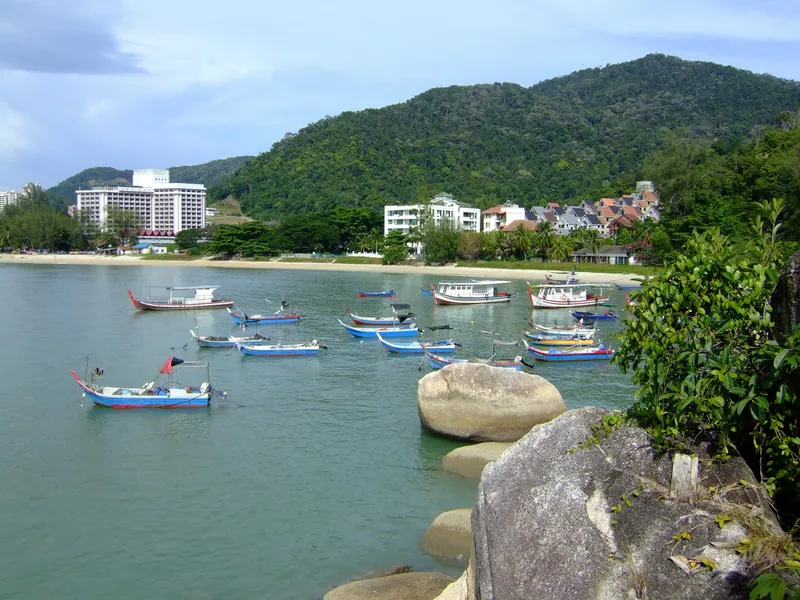
Batu Ferringhi is a suburb of George Town on the northern coast of Penang Island, about 11 km north-west of the city — today the island’s prime beach destination. But the name is far older than the resorts, and the story behind it is one of the more interesting in Penang.
What does “Batu Ferringhi” mean?
The name combines two ideas. Batu is Malay for “rock”, referring to the rocky shoreline here. Ferringhi (also spelt feringgi) is the modern form of the Classical Malay word peringgi, originally used for the Portuguese conquistadors and later for Europeans in general. So Batu Ferringhi means, in effect, “the rock where the foreigners came ashore” — often rendered simply as “Foreigner’s Rock.”
It’s a well-travelled word. Peringgi is cognate with the Thai farang, the Khmer barang and the Chinese Fólǎngjī, all descended from the Sanskrit firangī (itself from Arabic or Persian roots for “Frank”/European). Among Penang’s Tamil community the area is known as Paringgi Malai — “foreigner’s hill.” In Chinese, Batu Ferringhi is written 峇都丁宜.
A short history
European contact came early. In 1592, the English privateer Sir James Lancaster came ashore here aboard the Edward Bonaventure — the first European recorded to reach Penang Island — and spent the following months raiding passing ships.
For most of its history, though, Batu Ferringhi remained a quiet fishing village. That changed in the 1970s, when the first beachfront hotels were built and tourism took off; condominiums with sea views over the Strait soon followed. In December 2004, Batu Ferringhi was among the areas worst hit by the Indian Ocean tsunami, which claimed 52 lives in Penang.
The people of Batu Ferringhi today
As of 2020, around 9,000 people live in Batu Ferringhi, and the mix is distinctly Penang. Ethnic Chinese make up a little over 45% — predominantly Hokkien, with Penang Hokkien widely spoken — while Malays form roughly another two-fifths. The area also has an unusually high share of expatriates (close to 16%), reflecting its resort and international-school character, alongside a Penang Indian community. It’s a small place with a genuinely multicultural feel — and that shows up on the plate, from char kway teow to roti canai to fresh seafood.
Batu Ferringhi key facts
- Status
- Suburb of George Town, Northeast District, Penang Island.
- Distance
- ≈ 11 km north-west of George Town city centre.
- Beach
- ≈ 4 km of sand along the north coast.
- Population (2020)
- ≈ 9,046 — Chinese ~45%, Malay ~40%, expatriates ~16%, Indian.
- Name
- “Foreigner’s Rock”; Malay batu (rock) + ferringhi (European). Chinese: 峇都丁宜; Tamil: Paringgi Malai.
- Main road
- Jalan Batu Ferringhi (Federal Route 6), continuing to Teluk Bahang.
- Sources
- Drawn from Wikipedia (CC BY-SA) and our own research.
Want the practical side instead? Jump to where to stay, getting here, or the 3-day itinerary.
Good to know
Batu Ferringhi FAQs
What does Batu Ferringhi mean?
It means “Foreigner’s Rock.” Batu is Malay for rock (the rocky shoreline), and Ferringhi comes from the Classical Malay peringgi, used first for the Portuguese and then for Europeans generally — so the name marks the place where foreigners came ashore.
Why is it called Batu Ferringhi?
Because Europeans landed on this stretch of rocky coast. The English privateer James Lancaster came ashore here in 1592, the first European recorded to reach Penang Island, and the “ferringhi” (foreigner) name stuck to the rock — batu — at this spot.
How old is Batu Ferringhi as a resort?
The beach itself is ancient, but Batu Ferringhi only became a resort destination from the 1970s, when the first beachfront hotels were built. Before that it was a quiet fishing village.
What is Batu Ferringhi in Chinese?
It is written 峇都丁宜. Among Penang's Tamil community it is also known as Paringgi Malai, “foreigner's hill.”
How many people live in Batu Ferringhi?
About 9,046 as of 2020, with ethnic Chinese making up a little over 45% (largely Hokkien-speaking), Malays roughly another 40%, a high share of expatriates near 16%, and a Penang Indian community.
Partner with Batu Ferringhi's information hub
Running a hotel, restaurant, tour, homestay or local business in Batu Ferringhi — or want to advertise to high-intent visitors? Let's build something together.